.png?w=1400&h=1400)
.png?w=1200&h=1200)
.png?w=1000&h=1000)
.png?w=1400&h=1400)
.jpeg?w=800&h=800)
.jpeg?w=800&h=800)
-0.jpeg?w=800&h=800)
With People more care about the health lifestyle and the popular of the Pilates, more people are turning to home workouts as a practical solution to stay active and healthy. Gym memberships, packed class schedules, and bulky equipment can make fitness seem complicated. But what if you could achieve a strong, toned body with a single piece of equipment that fits into your living room, bedroom, or even a suitcase?
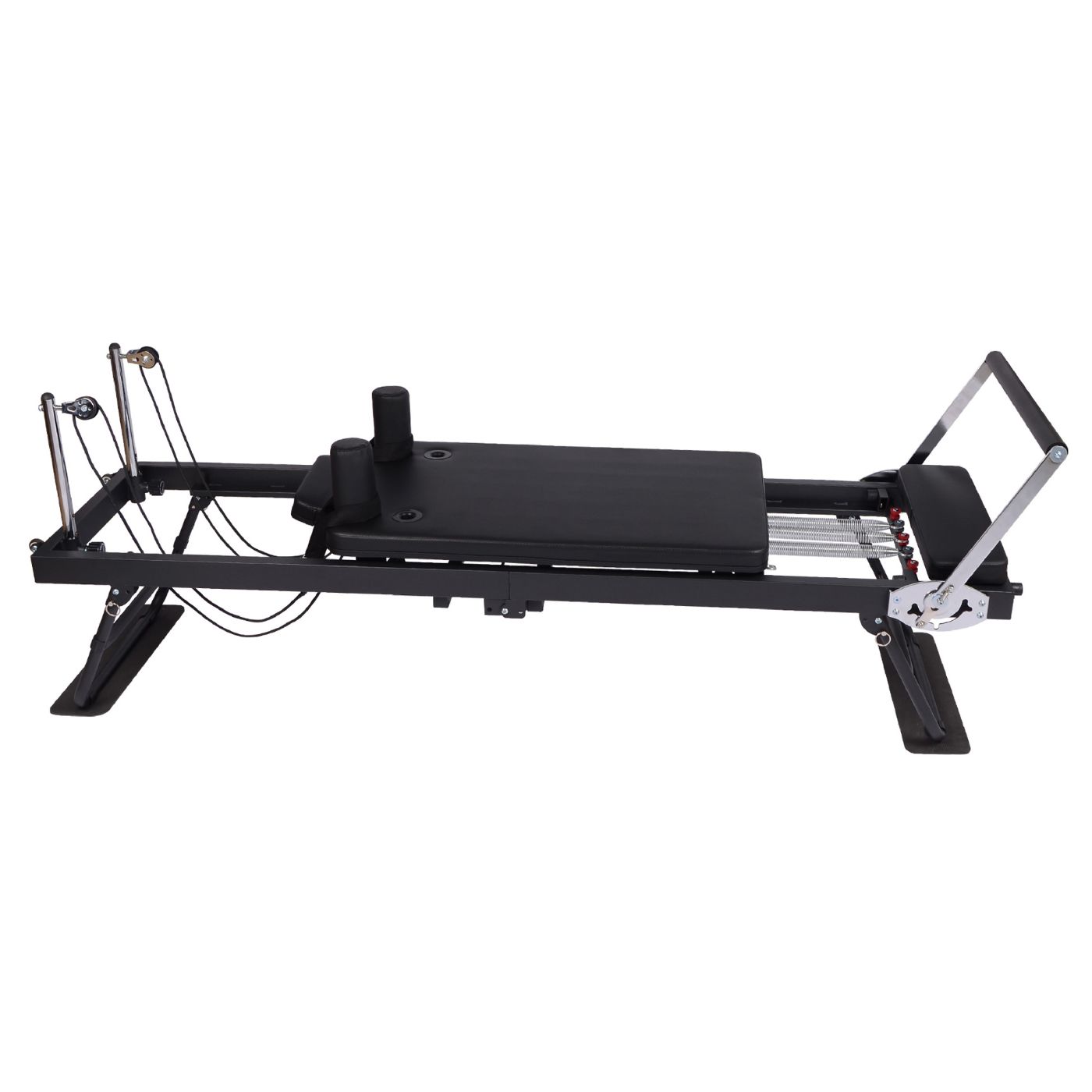
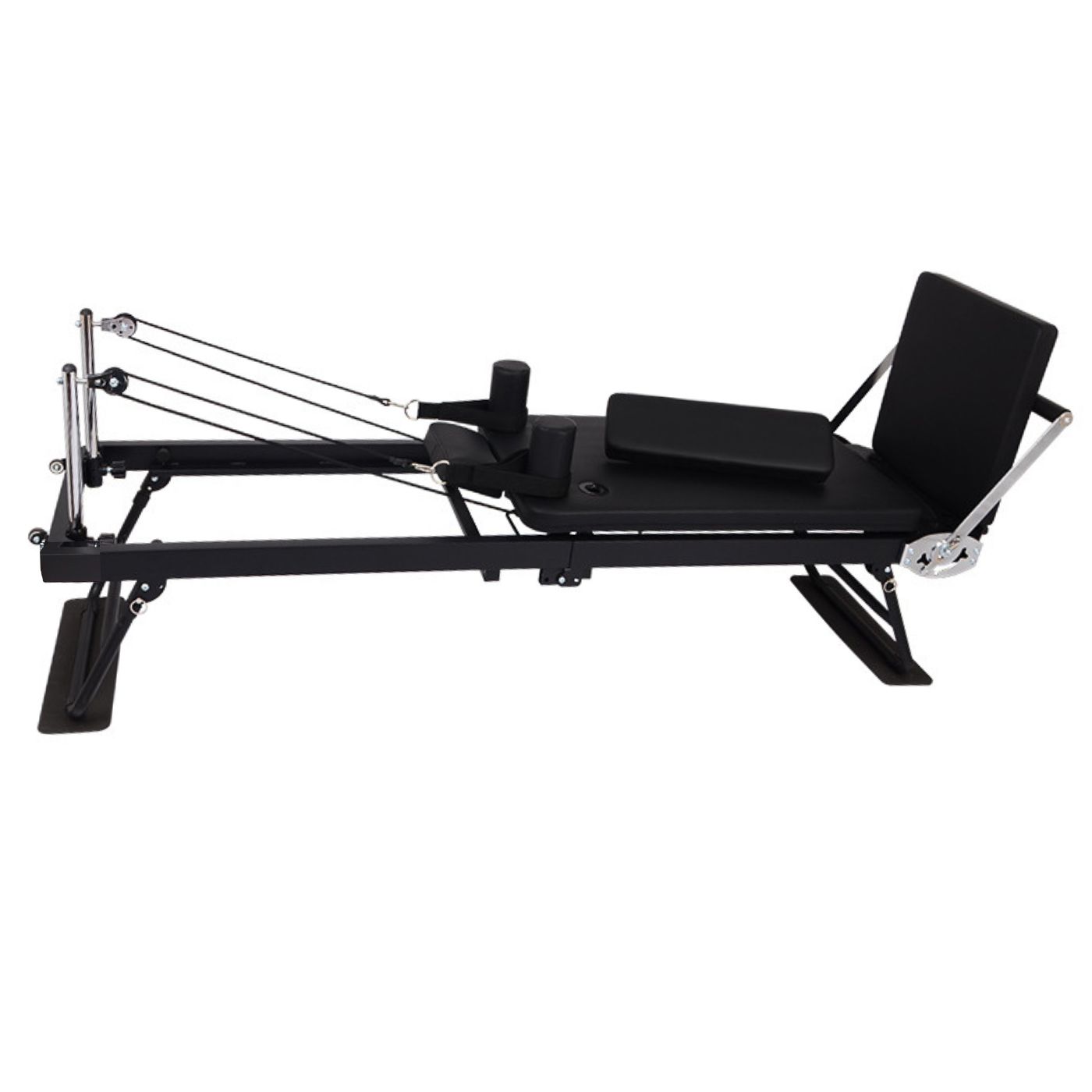
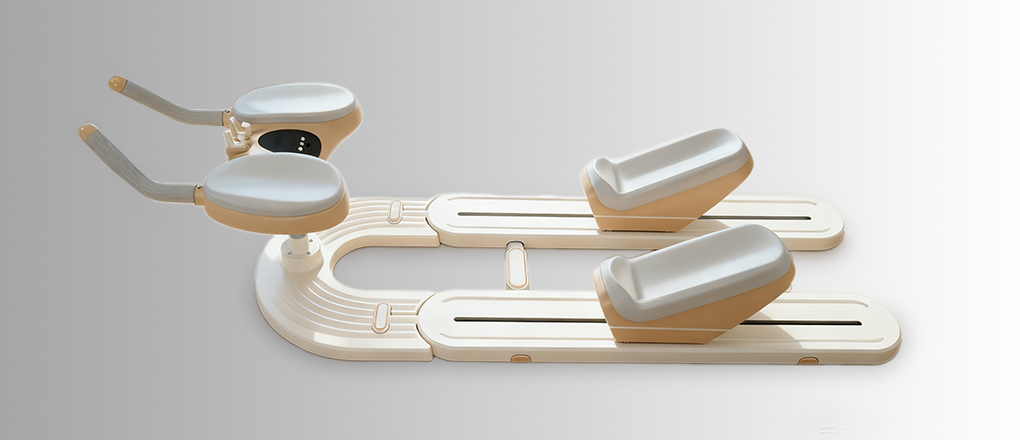
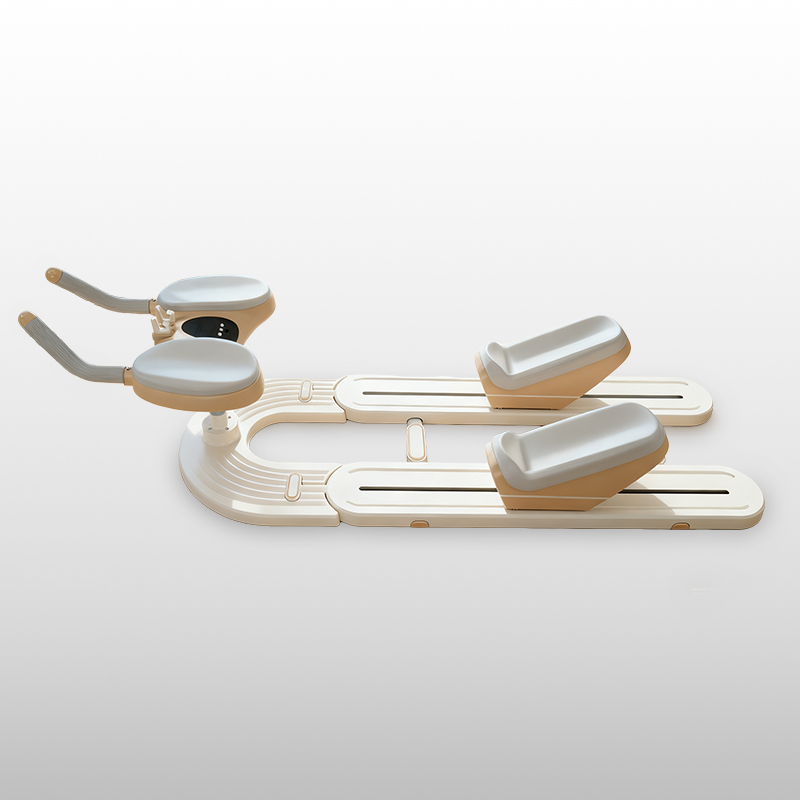
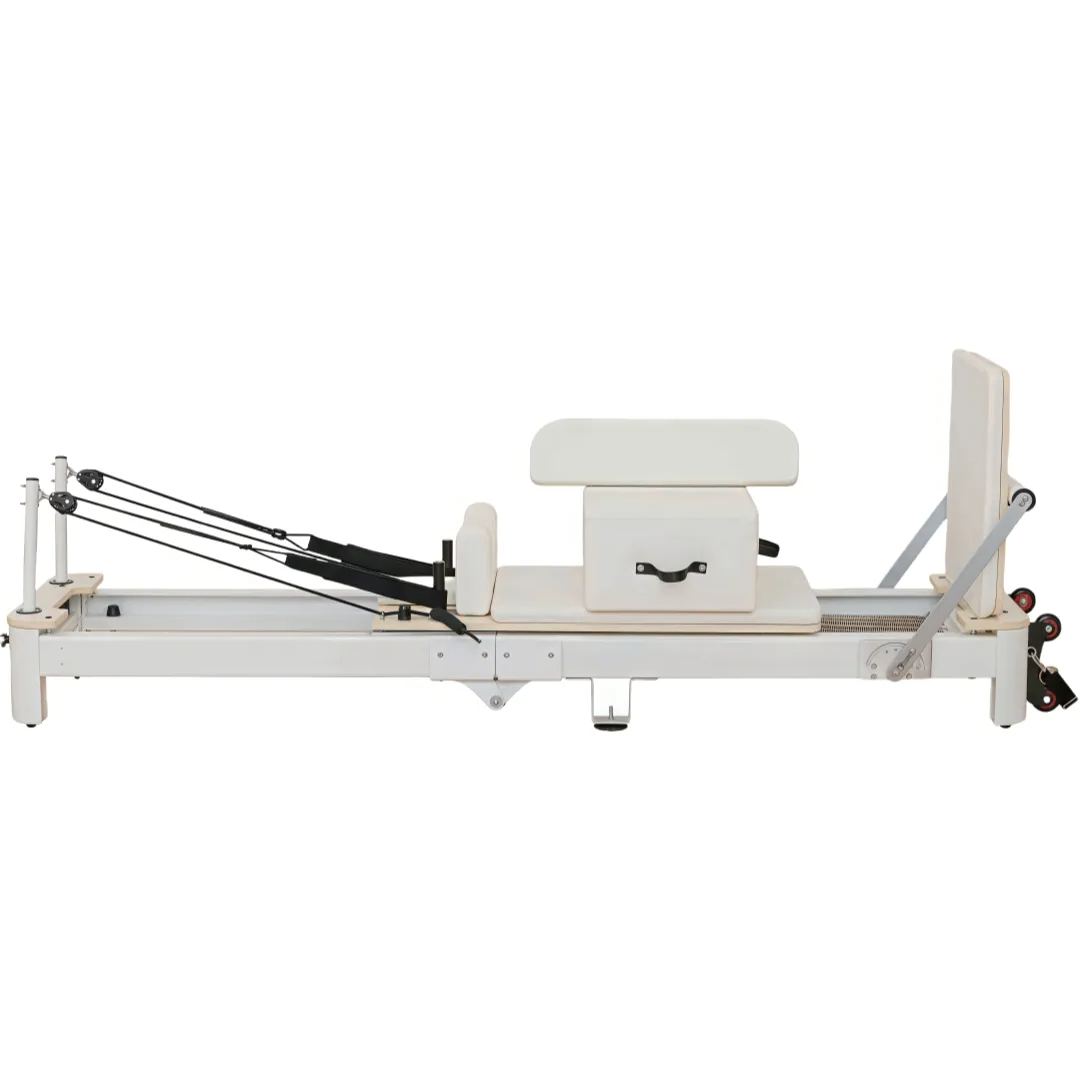
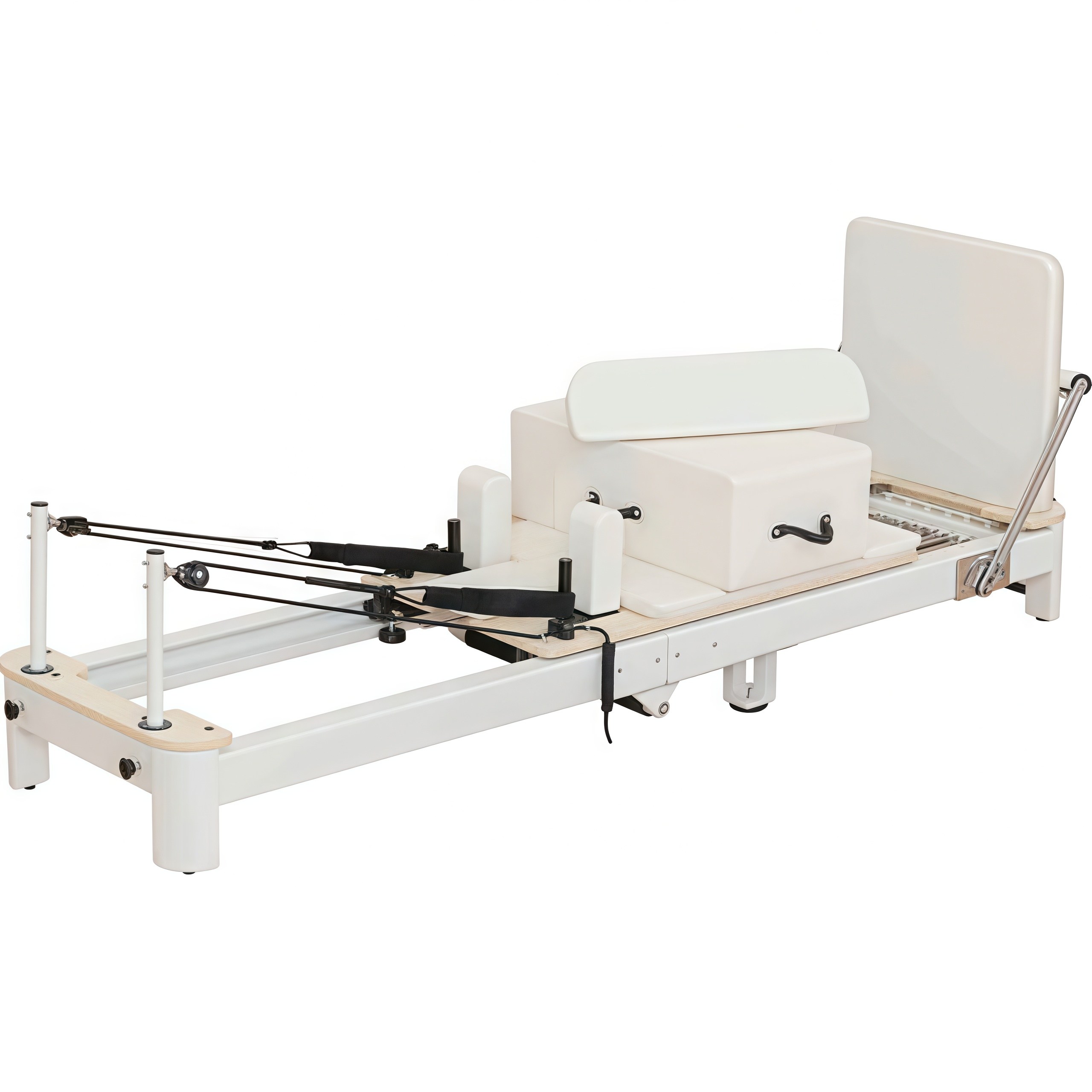
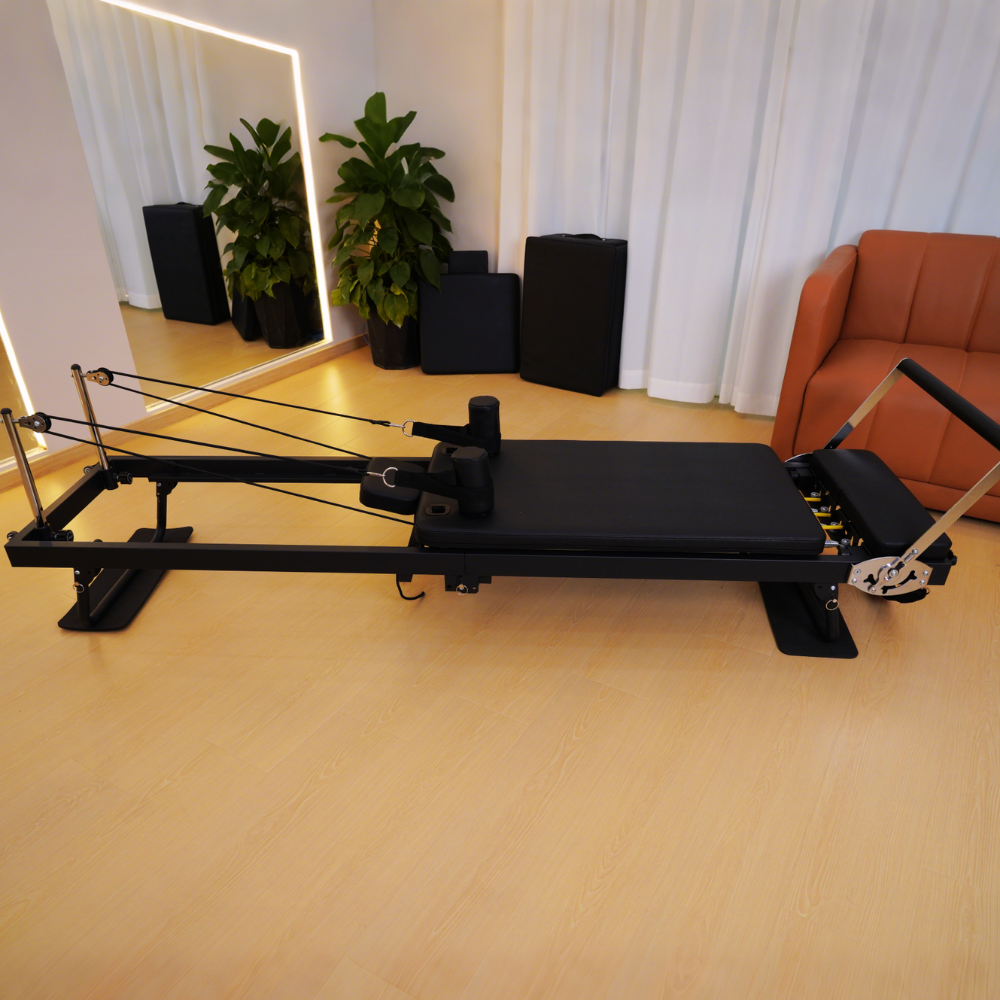
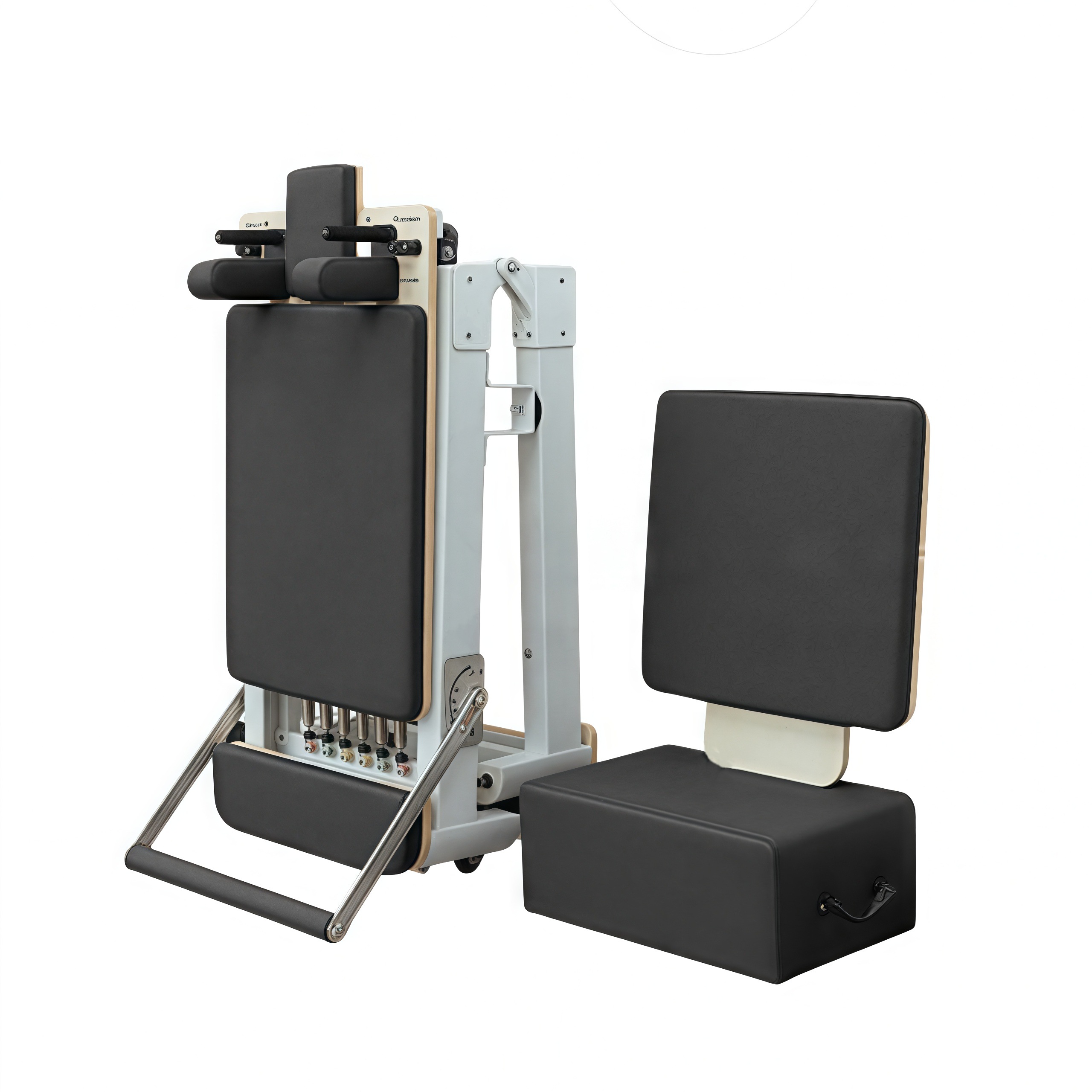
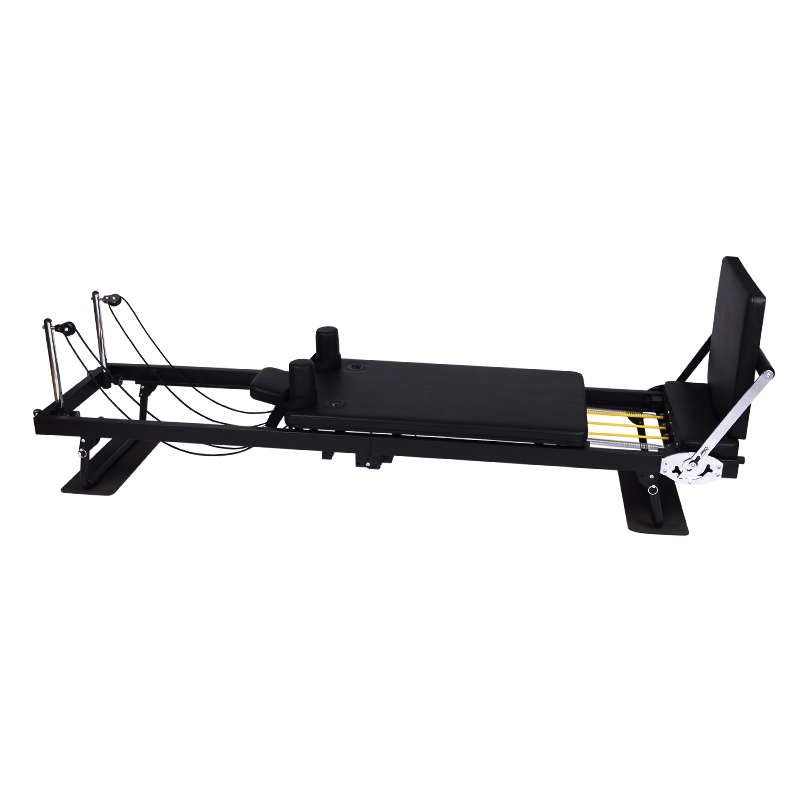
That’s where the Portable Pilates Board comes in. Compact, foldable, and incredibly versatile, it gives you the benefits of Pilates training—focusing on core strength, stability, and overall body conditioning—without the need for a full reformer machine or a studio membership.
Here are five easy exercises you can do at home using a Pilates Board. These moves are beginner-friendly, safe, and highly effective for building a stronger, healthier body.
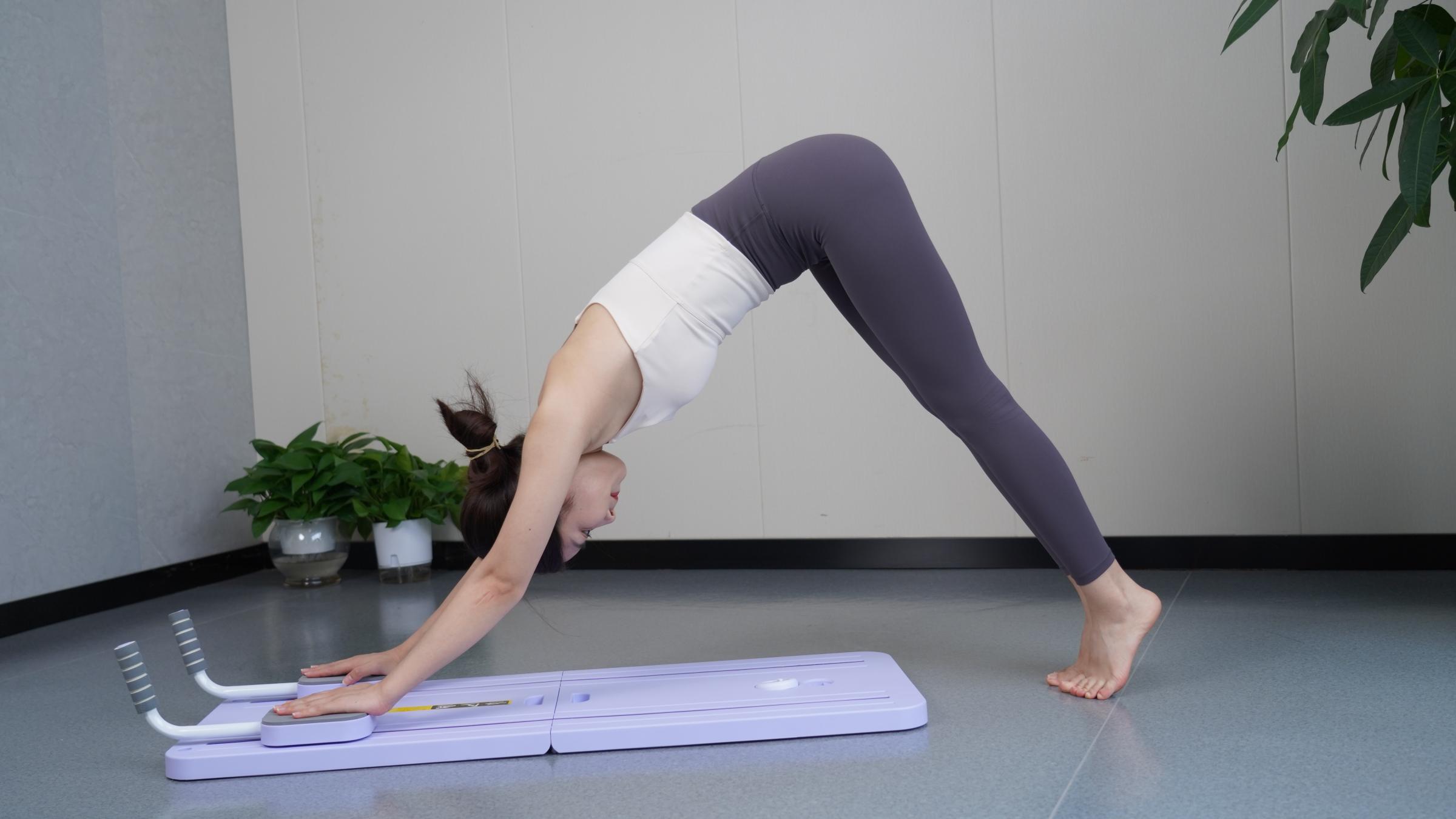
Why Use a Pilates Board at Home?
Before we start the exercises, let’s talk about why a Pilates Board is a suitable Pilates equipment for home workouts.
-
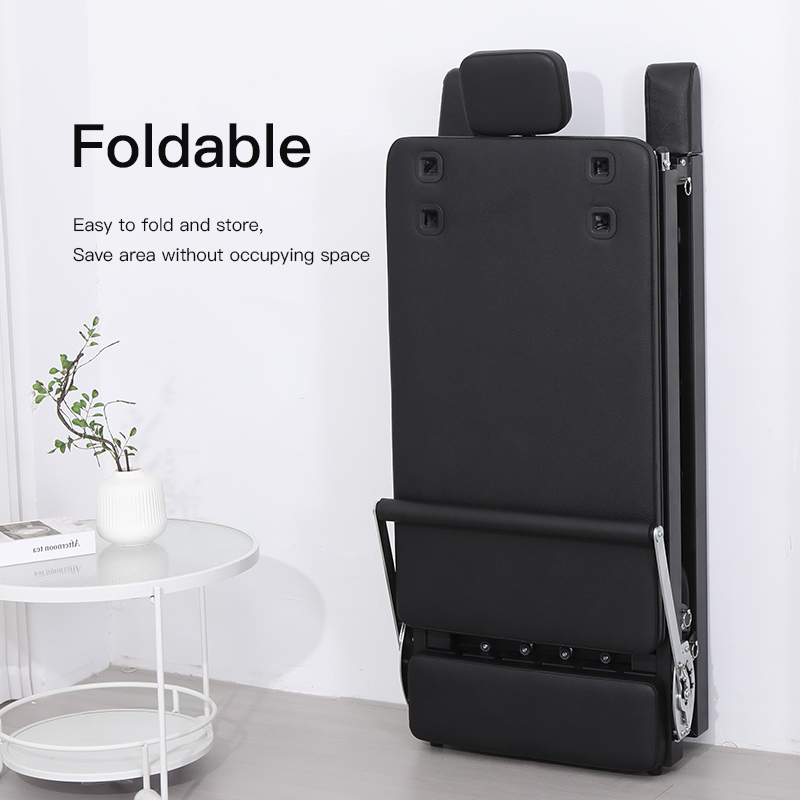
Convenience: The board folds up for storage and is lightweight enough to move around easily.
-
Versatility: It allows you to train your core, arms, legs, and glutes—all in one.
-
Beginner-Friendly: Unlike unstable tools such as the ab roller, the board provides a stable platform with resistance bands, making it safer for newcomers.
-
Cost-Effective: Instead of investing in multiple pieces of equipment or studio classes, one board can cover nearly all your training needs.
-
Portability: Perfect for small apartments, travel, or even outdoor workouts.
With these benefits in mind, let’s explore five easy exercises you can start today.
5 Easy Pilates Board Exercises
These exercises were chosen because they are simple, effective, and make full use of the JuSai 6-in-1 Portable Pilates Board’s features. They don’t require advanced experience, but with regular practice, they can deliver noticeable results.
1. Kneeling leg lift
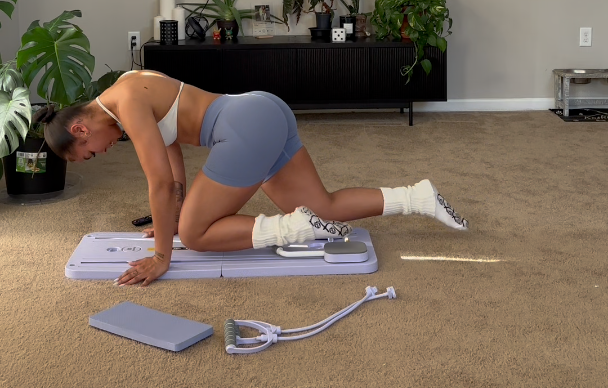
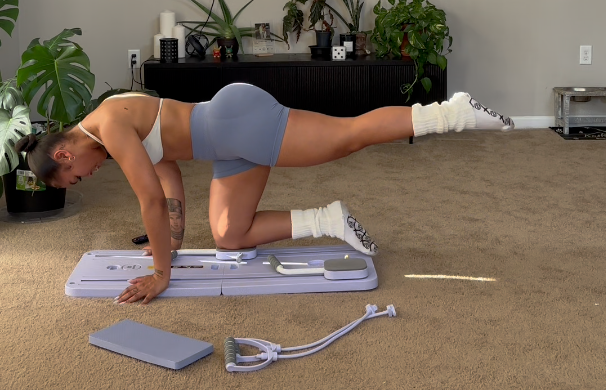
How to do the movement:
- Starting position: Kneel on a foam liner with your knees. Put your hands on the board, shoulder-width apart, with your arms perpendicular to the ground, and keep your back straight. Do not sag your waist or arch your back.
-
Movement process: Keep the pelvis stable, slowly lift one leg backward and upward. The knee can be slightly bent. When reaching the highest point, feel the contraction of the buttocks. Pause for a moment, then slowly lower the leg back to the starting position, and repeat the movement.
-
Exercised parts: It mainly exercises the gluteus maximus, and also helps to exercise the gluteus medius and gluteus minimus.
2. Bridge
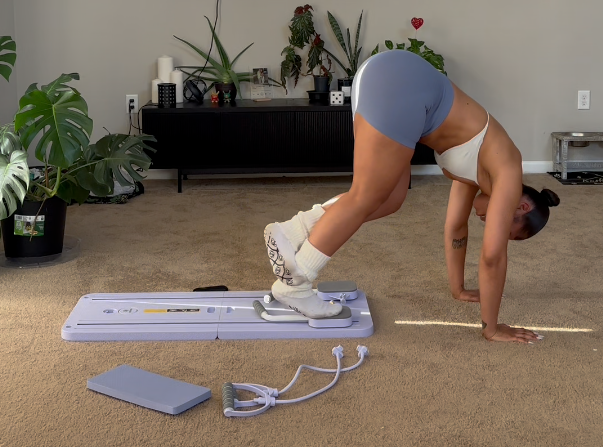
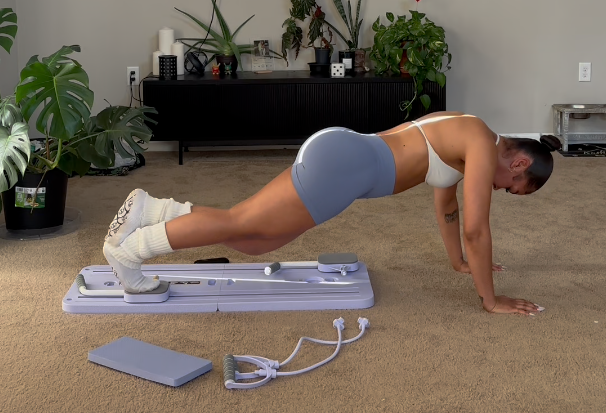
- How to do the movement
Starting position: Place your hands on the ground, shoulder-width apart, with your arms perpendicular to the ground. Put your feet on the foam liner of the fitness equipment, keep your body in a straight line from head to toe, tighten your core, and do not sag your waist or stick out your hips. - Movement process: Maintain stable breathing and doing hip bridge pose.
Exercised parts - Core muscles: This is the main part exercised by the plank, including rectus abdominis, obliques, transverse abdominis and deep pelvic floor muscles, etc.
3. Push
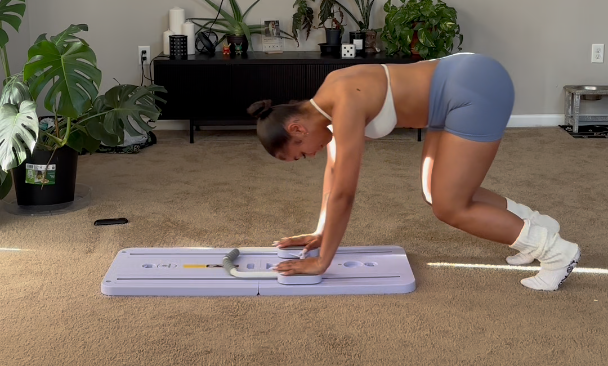
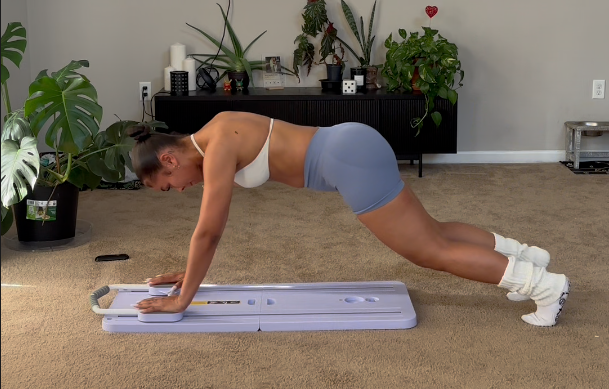
How to do the movement
- Starting position (Push - up preparatory position): Stand with your feet shoulder - width apart or slightly narrower. Lean your body forward and place your hands on the appropriate grips of the fitness board. Point your fingers forward, keep your arms slightly bent, maintain a straight back, tighten your core, and look at the ground.
- Movement process: Slowly lower your body by bending your arms, bringing your chest as close to the fitness board as possible while keeping your body in a straight line. Avoid sagging your waist or sticking out your hips. When your chest is close to the fitness board, pause for a moment, then push your body back to the starting position using the strength of your arms to complete one push - up. Repeat the above movement.
- Exercised muscles
Chest muscles: It mainly targets the pectoralis major. During the downward and upward phases of the push - up, the pectoralis major fully contracts and stretches.
Core muscles: Throughout the entire movement, to maintain the stability of the body, core muscles such as the rectus abdominis and obliques need to continuously exert force.
4. Side lunge performed exercise
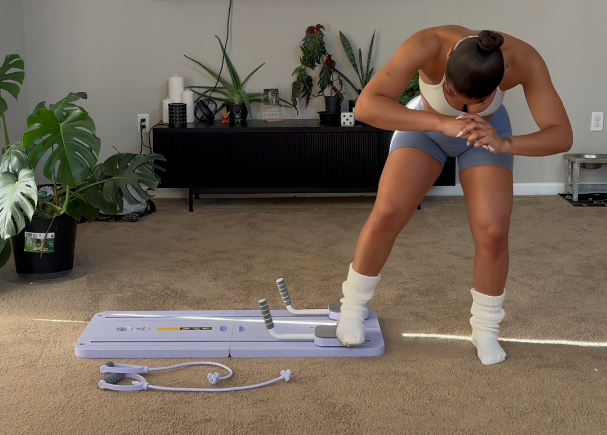
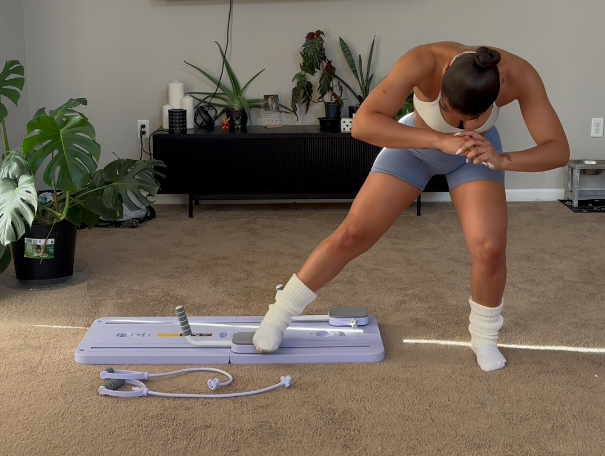
How to do the movement
- Starting position: Stand with your feet together next to the fitness board. Interlace your fingers and place your hands in front of your chest. Keep your back straight, tighten your core.
- Movement process: Step one foot onto the appropriate position of the fitness board. At the same time, shift your body's center of gravity to the side where you stepped on the board. Step the other foot to the same side, bend your knee, and perform a side lunge, making your thigh nearly parallel to the ground while keeping your body stable and avoiding wobbling.
- Exercised muscle groups
Leg muscles: It mainly targets the adductor muscles on the inner side of the thighs, as well as the quadriceps on the front side and the hamstrings on the back side of the thighs.
Hip muscles: Muscles such as the gluteus maximus and gluteus medius also participate in exerting force to help maintain body balance and complete the movement.
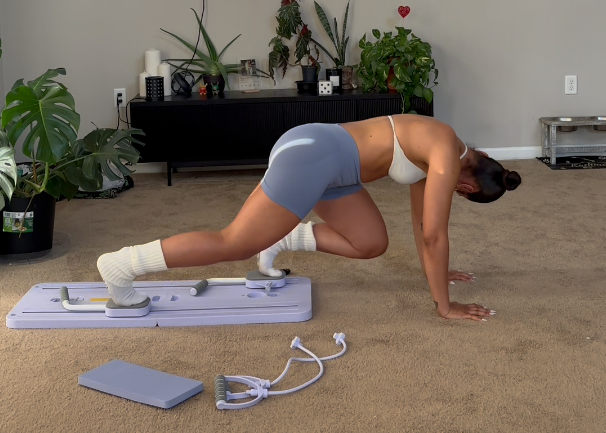
5. Mountain climber
How to do the movement
- Starting position: Place your hands on the Pilates board, shoulder-width apart. Straighten your arms and keep them perpendicular to the ground. Put your feet on the corresponding positions of the fitness board. Keep your body in a straight line, tighten your core, and maintain stability, similar to the starting position of a plank.
- Movement process: Keep your core continuously tightened. Lift one knee quickly towards your chest, trying to get it as close to your chest as possible, then quickly retract it. Repeat the action with the other knee, just like the leg-lifting action when running. Do it alternately and quickly, and keep your breathing even. Do not hold your breath.
- Exercised muscle groups
Core muscles: Throughout the entire movement, to maintain the stability of the body, core muscle groups such as the rectus abdominis, obliques, and transverse abdominis need to continuously exert force.
Leg muscles: It mainly exercises the quadriceps, hamstrings, and calf muscles.
Sample Beginner Routine
Here’s how you can put these five exercises together into a quick home workout:
-
Warm-up (3 minutes): gentle stretches, torso twists, and light marching in place.
-
Main Workout:
-
Kneeling leg lift – 10–12 reps per side
-
Bridge – 8–10 reps
-
Push – 12–15 reps
-
Side lunge performed exercise – 10 reps per side
-
Mountain climber – 12 reps
-
-
Sets: 2–3 rounds, depending on fitness level
-
Cool-Down (3–5 minutes): Child’s Pose, hamstring stretch, and deep breathing.
In just 15 minutes, you can complete a full-body workout focused on core strength, balance, and stability.
Safety Tips for Beginners
When starting with a Pilates Board, keep these tips in mind:
-
Check setup: Ensure the board is fully unfolded and stable on a non-slip surface.
-
Secure resistance bands: Double-check the attachment points before pulling.
-
Focus on control: Pilates emphasizes slow, precise movements—not speed.
-
Engage your core: Always keep abdominal muscles pulled in to protect your spine.
-
Listen to your body: Stop if you feel sharp pain or discomfort.
Why the JuSai 6-in-1 Portable Pilates Board Is Perfect for Home Workouts
Not all Pilates Boards are created equal. The JuSai 6-in-1 Portable Pilates Board offers unique advantages:
-
Six functions in one: Core training, resistance work, stretching, squats, Pilates-inspired movements, and more.
-
Foldable design: Easy to store in small spaces or carry on the go.
-
Safe and durable: Non-slip surface and sturdy build for stability.
👉 Ready to start? Shop the JuSai 6-in-1 Portable Pilates Board here
Home fitness doesn’t have to be complicated. With just one compact tool—the Pilates Board—you can unlock effective workouts that strengthen your core, tone your muscles, and improve your posture.
The five exercises we’ve covered are simple enough for beginners yet powerful enough to deliver real results when practiced consistently. Start with 2–3 sessions a week, build confidence, and gradually increase intensity as you grow stronger.
With the JuSai 6-in-1 Portable Pilates Board, you’ll have everything you need for a convenient, safe, and versatile home workout system.
And we will add more exercise routines in next. See you.
.png?w=1400&h=1400)
.jpeg?w=1400&h=1400)
.jpeg?w=4000&h=4000)
.jpeg?w=4000&h=4000)
.jpeg?w=2560&h=2560)
.jpeg?w=800&h=800)
.jpeg?w=743&h=743)